
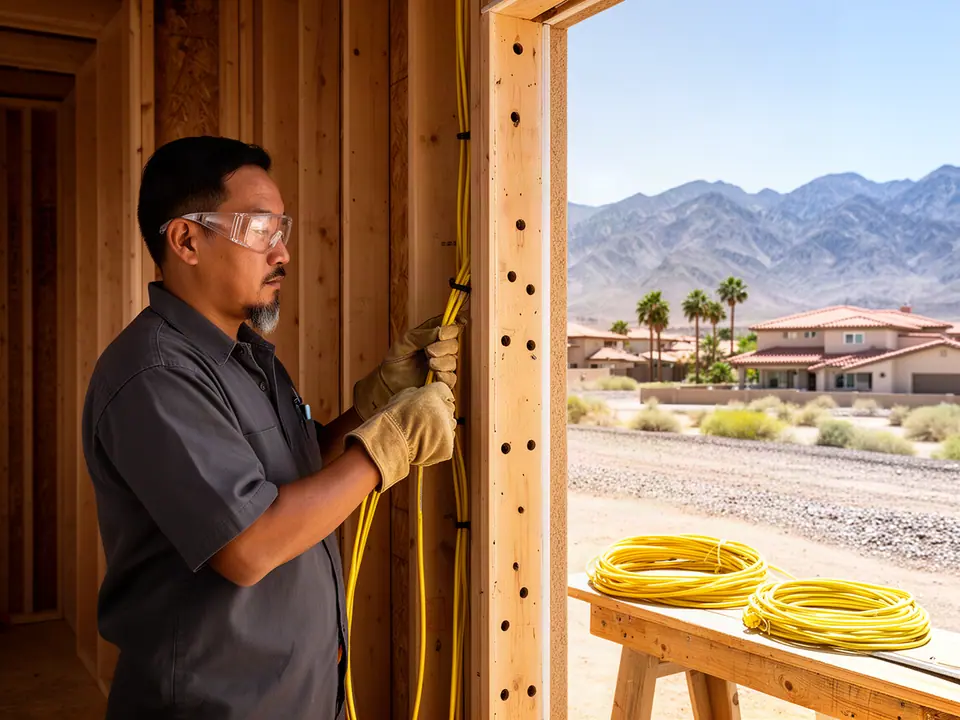
Haleridge Commercial Capital, a small-business funding service in Las Vegas, Nevada, prepares funding requests for electrical contractors in Clark County, NV. Commercial and new-build electrical work can run on draw schedules, and vans, lifts and tools need replacing, so lines of credit, equipment financing and working capital are the fits to weigh.
| Electrical contractor employer establishments, Clark County, NV (2023) | 455 |
|---|---|
| Paid employees | 10,481 |
| Under five employees | 44.2% |
| Electrical nonemployers (2024) | 823 |
Where an electrical contractor's money goes first
Electrical work is material-heavy at the start. Wire, conduit, panels and fixtures can be a large share of a commercial job's cost, and much of it is bought before rough-in. Journeymen and apprentices are paid on a regular schedule. Payment arrives through the general contractor's draws, after inspections, with retainage held back. Electrical contractor financing can be mostly about carrying that front-loaded cost.
Commercial draw cycles and a line of credit
A line of credit suits the draw cycle: draw to buy material and cover payroll, repay when the draw clears. Because commercial electrical jobs can run for months, the line also carries retainage until closeout. For a single unusually large job, a working capital loan sized to that job is an alternative.
Illustration only
A hypothetical east-valley electrical contractor wins a $240,000 warehouse lighting and power job. Switchgear and wire run $70,000 before rough-in; three weeks of crew payroll add $36,000. The first draw comes after the rough-in inspection. A line drawn for $106,000 and repaid across the draws covers it. These numbers are invented to show the pattern, not typical costs or offers.
Electrician equipment financing options
- Service vans and trucks, with racking.
- Scissor lifts and boom lifts.
- Trenchers and directional boring equipment.
- Testing and thermal imaging equipment.
All of these can go through equipment financing. Lifts and trenchers may hold resale value, which partners can weigh.
Business loans for electrical companies growing into commercial work
Moving from residential service to commercial contracts can change the cash cycle: bigger jobs, longer payment terms and more material up front. A company making that move may need a line of credit sized to the larger jobs and possibly a term loan for a larger shop or yard. Partners will want to see that the commercial backlog exists.
How to get an electrical contractor license, and why partners care
Partners reviewing electrical contractor requests may ask for license details. Confirm with the licensing office what applies to your work. The Nevada contractors license guide explains how to look up and document a license for a funding file.
What partners typically review
- Business bank statements with draw deposits.
- Backlog and contract values.
- Receivables and retainage.
- Equipment quotes and existing equipment debt.
Wiring and electrical firms counted in Clark County, NV
Clark County, NV had 455 electrical contractor employer establishments in 2023, with 10,481 paid employees; 44.2% had fewer than five employees (County Business Patterns 2023). Ten were in ZIP 89115 (ZIP Code Business Patterns 2023), and 823 electrical businesses had no payroll in 2024 (Nonemployer Statistics 2024).
The broader contractor picture is on the contractor page; other trades are on the industries hub; local figures are on the Las Vegas, NV page.
Lighting retrofits and service work: a different cash pattern
Not all electrical work runs on draws. Lighting retrofits, tenant service calls and small commercial jobs may be invoiced on completion and paid on 30-day terms. A contractor with a mix of draw-based new construction and invoice-based service work has two cash cycles at once; partners will want to see both in the statements, and a line of credit can serve both.
Tracking which deposits come from which kind of work can help the conversation with a partner.
By Haleridge Commercial Capital · Updated